




Technical SEO Meets AI: How LLMs Read (and Cite) Your Website

By eXcelisys
· 81 views
Technical SEO Meets AI: How LLMs Read (and Cite) Your Website
Why does the same technical foundation that wins Google rankings now decide whether ChatGPT, Gemini, and Perplexity cite your business at all.
The digital landscape has shifted from a library of links to an engine of answers. As large language models (LLMs) like GPT-5, Claude, and Gemini (and many others) become the primary way people consume information, the goal of SEO has changed with them. It’s no longer just about ranking #1 on the results page. It’s about being the source an AI trusts enough to cite when it generates a response.
In our earlier article, Technical SEO in Plain English, we broke down what technical SEO actually is: the under-the-hood work covering site speed, crawlability, mobile-friendliness, site structure, and structured data that determines whether Google can understand and rank your website. That article is still the right place to start if you want the plain-English version. This one picks up where it left off and goes a layer deeper, because those same fundamentals now determine whether AI systems can read, trust, and cite your site as well.
A Quick Recap: The Three Pillars
Technical SEO rests on the same building blocks whether the reader is a Google crawler or an AI model. As we covered in the Plain-English guide, those pillars are crawlability and indexability, site speed and Core Web Vitals, and structured data. What’s changed is the audience. Search engines used to be the only automated reader of your website. Now AI crawlers and retrieval systems are reading it too, and they’re far less forgiving of a messy technical foundation.
Why Technical SEO Is Critical for LLMs
In 2026, LLMs don’t just read your site the way a search engine does. Many ingest it to train models or to answer questions in real time through a process called Retrieval-Augmented Generation, or RAG, where the AI pulls live facts from your pages to construct its answer. That distinction matters, because it raises the bar for how cleanly your content needs to be structured.
1. Extractability Is the New Ranking
If your site’s code is heavy with unnecessary JavaScript, broken links, or non-semantic HTML, an AI crawler is likely to skip it. To appear in an AI overview or a generated answer, your data has to be extractable: an AI needs to be able to pull the relevant facts from your page quickly and reliably. If it can’t, it will cite a competitor whose site is technically cleaner, even if your content is better.
2. Feeding the Knowledge Graph
LLMs reason in terms of entities: concepts, people, brands, products. Structured Data (Schema Markup) is how you hand-feed those entities directly to the AI. By marking up your pages with schema, you’re not hoping the AI figures out what your business does. You’re handing it a map that identifies your brand as an authority in its niche, in a format machines can read at a glance.
3. Server-Side Rendering
Googlebot has gotten better at rendering complex JavaScript over time, but many AI crawlers still favor static HTML they can parse immediately. If your site leans heavily on client-side frameworks like React or Vue without a server-side rendering strategy, you may be effectively invisible to a growing share of the bots powering AI-driven search, even on a site that looks great to a human visitor.
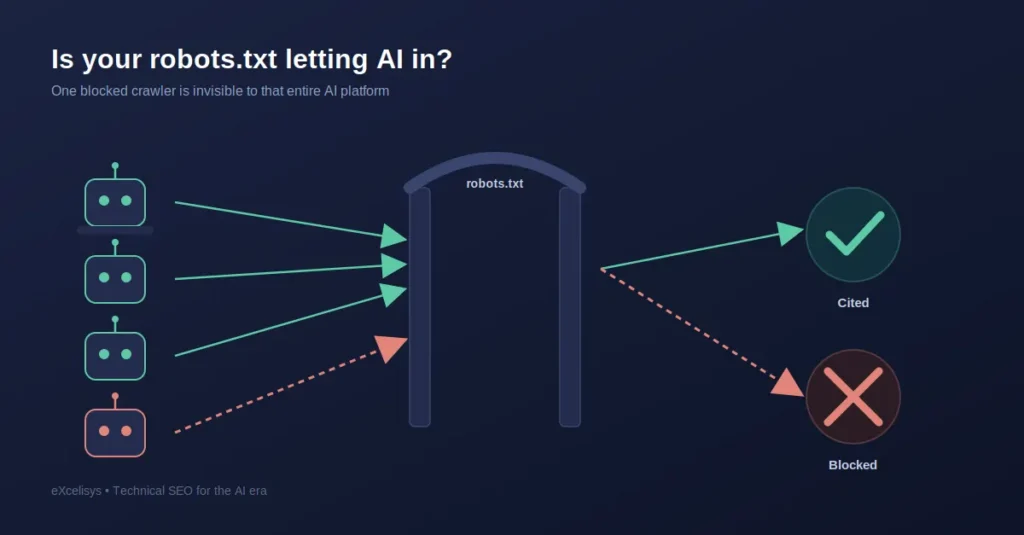
4. Are You Even Letting AI In?
Before any of the above matters, there’s a more basic question: is your robots.txt file letting AI crawlers reach your site in the first place? A surprising number of sites, sometimes without realizing it, block bots like GPTBot (OpenAI), ClaudeBot (Anthropic), PerplexityBot, or Google-Extended (the crawler that feeds Google’s AI Overviews, separate from classic Googlebot). You can have perfect Core Web Vitals and flawless schema and still be invisible to AI if a blanket disallow rule is quietly turning these crawlers away. It’s a five-minute check and one of the highest-leverage items in an AI-readiness audit, because unlike “extractability” it’s a simple yes-or-no you can verify yourself.
Where This Builds On the Fundamentals
None of this replaces the fundamentals from the Plain-English guide; it raises their stakes. A slow site was always a ranking problem. Now it’s also an extractability problem, since AI crawlers are resource-heavy and prioritize pages that load quickly. Thin or duplicate content was always an indexation problem. Now it’s also a trust problem, since an AI weighing which source to cite has little patience for pages that don’t clearly say what they mean. The audit priorities are the same ones outlined in the earlier article. The cost of getting them wrong has gone up.
The eXcelisys Advantage
This is where the art of SEO meets the science of development. At eXcelisys, we don’t treat SEO as a marketing checklist to hand off. As a development partner, we view it as a core engineering requirement, because most SEO firms find the problems. We fix them, because we built the site in the first place.
With over two decades building complex, database-driven systems and custom web applications, we understand the under-the-hood architecture that AI crawlers demand. From optimizing FileMaker-to-web integrations to helping WordPress sites hit strong Core Web Vitals scores, our eXpertise is in making your technical foundation as solid as your content. We don’t just help you get found. We help you get cited.
Ready to Future-Proof Your Digital Presence?
The shift from search to answers is already here. Is your website technically prepared to be the answer? Contact us for an initial consultation, and read the Technical SEO in Plain English article for the full breakdown of where a technical SEO engagement starts.
The post Technical SEO Meets AI: How LLMs Read (and Cite) Your Website appeared first on eXcelisys.
Recommended Comments